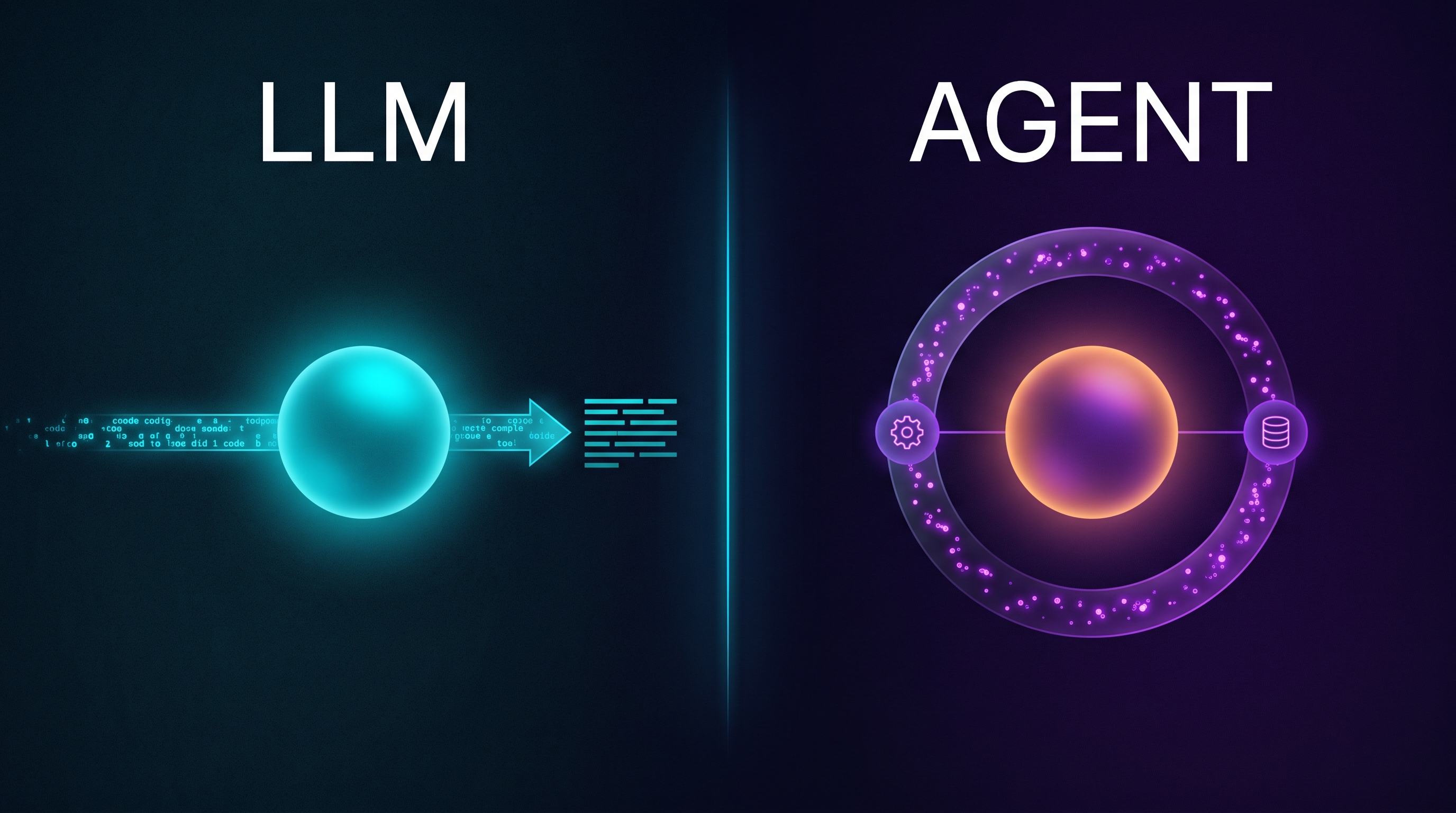
In the previous post, I broke down what an AI agent actually is and why the term suddenly showed up everywhere. That post leaned on one distinction I skipped past quickly, and it's the one that trips up almost everyone new to this space: an LLM and an AI agent are not the same thing, even though the two terms get used interchangeably in half the LinkedIn posts you'll read this week.
An LLM is a text-prediction engine — you send it a prompt, it sends back a completion, and the interaction is over. An AI agent is a system built around an LLM that lets the model take actions, look at the results of those actions, and decide what to do next, repeating that cycle until the task is actually finished. Every agent has an LLM somewhere inside it. Calling an LLM a few times from inside a chat UI does not make it an agent.
Why this mix-up happens so often
Part of the problem is marketing. Once "agent" became the word investors wanted to hear, every chatbot, every RAG pipeline, and every Zapier automation got rebranded as an "AI agent" overnight. The other part of the problem is that, from the outside, a good agent and a good chatbot can look identical. Both take a message and return a helpful response.
Take customer support. A bot that only pulls answers from an FAQ database is using an LLM, but it isn't an agent — it never acts on anything, it just retrieves and rephrases. A bot that checks an order's status through an API, decides on its own that a refund is warranted, and actually issues it — that's agent behavior, because it acted, observed the result, and decided again.
What an LLM actually does — and where it stops

Strip away every framework and every product name, and an LLM is a function. You give it a sequence of tokens, it predicts the next ones, and it stops when it decides the response is complete. That's it. It has no memory of your last message unless you paste that message back into the new prompt. It cannot check whether its own answer was correct. It cannot go look something up unless you've wired that lookup in yourself. A raw LLM call is a single round trip: input in, text out, done.
This isn't a limitation someone forgot to fix — it's just what a language model is. The "intelligence" people talk about lives entirely in how well it predicts the next token given everything that came before it. Nothing in that description involves acting on the world or carrying a decision across more than one response.
What actually turns an LLM into an agent

An agent wraps that same prediction engine in a loop, and gives it three things a plain LLM call doesn't have:
- Tools — functions the model can choose to call (search the web, query a database, hit an API) instead of only generating text.
- Memory — some way of carrying state across steps, so the fifth decision knows what happened in the first four.
- A loop — the part that actually matters most. After the model acts, something feeds the result of that action back in, and the model decides again. It keeps deciding until it has an answer, not just a completion.
That loop is the entire difference. Not the model. Not the prompt. Not even the tools by themselves — you can hand an LLM a tool and never let it call it more than once, and you still don't have an agent, just a slightly fancier single request.
Seeing it in code, not just in theory
Here's a plain LLM call. One request, one response, nothing in between:
// llm-only.ts
import OpenAI from "openai";

const client = new OpenAI();

async function askOnce(question: string) {
  const response = await client.chat.completions.create({
    model: "gpt-4o-mini",
    messages: [{ role: "user", content: question }],
  });
  return response.choices[0].message.content;
}

const answer = await askOnce("What's the capital of Bangladesh?");
console.log(answer);
Now here's the same model, wired into a minimal agent. Same API, same account, same billing — the only thing that changed is a loop and a tool:
// minimal-agent.ts
import OpenAI from "openai";

const client = new OpenAI();

const tools = [
  {
    type: "function" as const,
    function: {
      name: "get_time",
      description: "Returns the current server time",
      parameters: { type: "object", properties: {} },
    },
  },
];

function getTime() {
  return new Date().toISOString();
}

async function runAgent(question: string) {
  const messages: any[] = [{ role: "user", content: question }];

  while (true) {
    const response = await client.chat.completions.create({
      model: "gpt-4o-mini",
      messages,
      tools,
    });

    const message = response.choices[0].message;
    messages.push(message);

    if (!message.tool_calls) {
      return message.content;
    }

    for (const call of message.tool_calls) {
      const result = call.function.name === "get_time" ? getTime() : null;
      messages.push({
        role: "tool",
        tool_call_id: call.id,
        content: JSON.stringify(result),
      });
    }
  }
}

const answer = await runAgent("What time is it right now?");
console.log(answer);
Read the second file slowly. The model didn't get smarter. The prompt isn't more clever. The only structural change is the while loop that lets the model call a tool, see the result, and decide again before answering. That loop is the entire distance between "using an LLM" and "running an agent."
The architecture, in one picture
flowchart LR
    A[User asks a question] --> B{LLM decides}
    B -->|needs more info| C[Call a tool]
    C --> D[Tool returns a result]
    D --> B
B -->|has enough to answer| E[Final answer returned]Flow summary: The user's question goes to the LLM, which decides whether it can answer directly or needs to call a tool first; if it calls a tool, the result gets fed back to the LLM, and this repeats until the model has enough to give a final answer.
The mistake I made when I thought I'd built my first agent
The first "agent" I ever built wasn't one. I'd wrapped a chat completion call in a for-loop that just re-asked the model the same question with a slightly reworded prompt every time it didn't like the first answer. It felt like magic for about ten minutes, because the responses did get better on retries. Then I actually looked at what was happening in the logs: there was no tool call, no state carried between iterations, nothing being checked against the real world. It was one model, guessing better on its second and third try at the exact same static prompt. I'd built a retry loop and called it an agent.
What actually changed my mental model was adding a single real tool — nothing fancy, just a function that hit an API and returned a JSON result — and watching the model choose to call it, read the result, and change its next message based on what came back. That's the moment a wrapped API call turns into something that's actually deciding, not just generating.
Common mistakes people make when they say "I built an agent"
- Calling a single tool-enabled call an agent. If the model can call a tool but the code only lets it happen once per request, you've built a slightly smarter API call, not an agent — there's no loop, so there's no room for the model to change course.
- Confusing a long system prompt with autonomy. A 2,000-word system prompt full of instructions doesn't make a system decide anything on its own; it just makes each individual response more constrained.
- Skipping memory and calling it "context." Passing the same static chat history back in every time isn't memory — real agent memory means the system stores something from a past run and retrieves it in a later, separate one.
- Assuming more tools automatically means more capability. A model with fifteen tools and a bad loop will get stuck in worse ways than a model with two tools and a clean one. The loop design matters more than the tool count.
When a plain LLM call is actually the right choice
Not everything needs an agent. A static FAQ answer, a one-off lookup, a single-step translation — these are all faster, more predictable, and easier to debug as a plain LLM call. Building agent-loop complexity where none of it is needed is its own common mistake, right alongside the ones above.
Frequently Asked Questions
Is every chatbot built on an LLM an AI agent? No. If the chatbot takes one message and returns one response without deciding to take an action based on what it gets back, it's a well-dressed LLM call, not an agent.
Do I need a framework like LangChain to build an agent? No — the two code samples above are the entire minimum an agent needs: a model, a tool, and a loop. Frameworks add convenience for bigger systems, but they don't add the concept.
Can a plain LLM eventually turn into an agent on its own, without extra code? No. The model itself doesn't change; what changes is the system you build around it. An LLM never decides to start looping or calling tools by itself — that structure has to be built.
Need a High-Performance Web App or Custom AI Solution?
I help founders, businesses, and engineering teams build lightning-fast web applications, resilient backend architectures, and intelligent AI workflows. Have an idea in mind? Let’s bring it to life.
Found this article helpful?
Give some claps to support more in-depth engineering logs!
Tags
Zahid Hasan Tonmoy
Author & Developer
MERN Full Stack Developer & AI Agent Developer based in Dhaka, Bangladesh. Writing about web development, React, PostgreSQL and my learning journey.