Jerseyvault: Engineering a Resilient E-Commerce Architecture with React & Supabase
A high-performance sports apparel e-commerce platform built with React & Supabase.
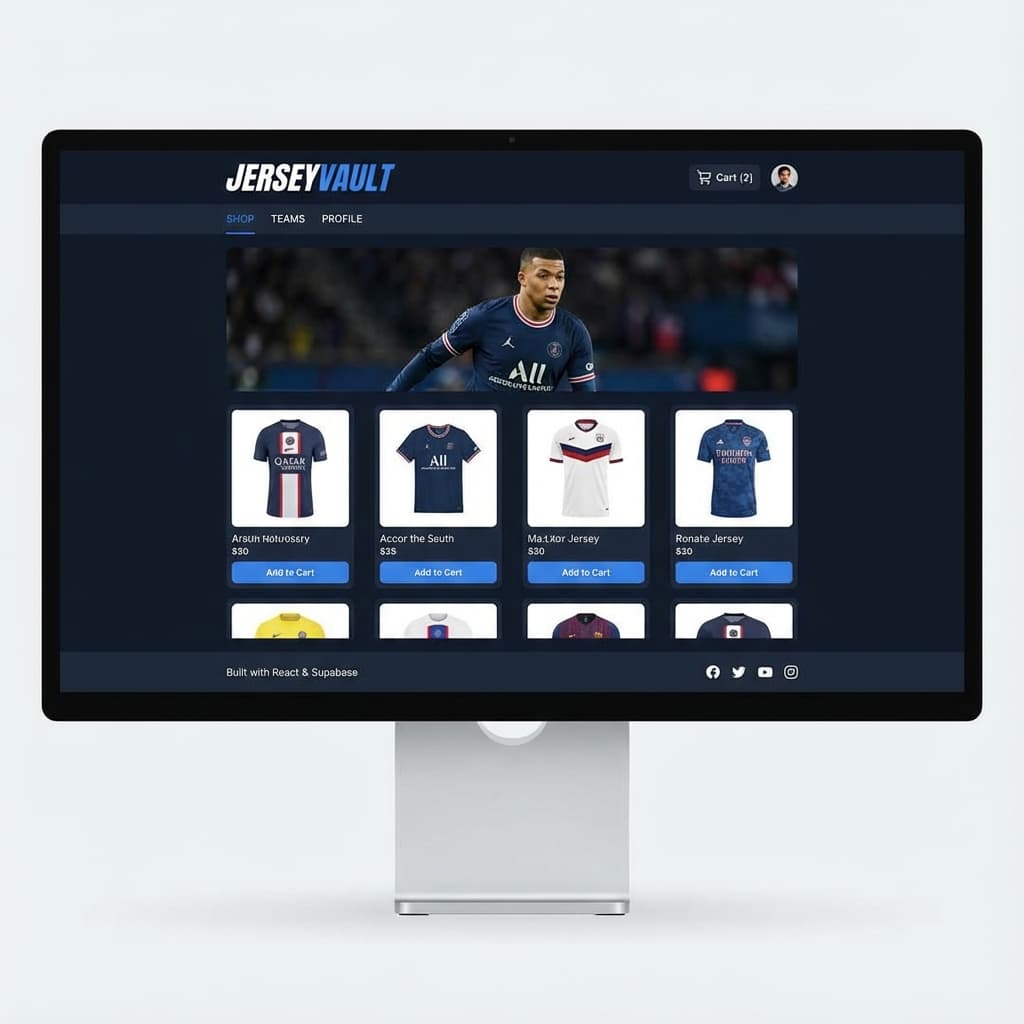
Sports enthusiasts and niche apparel sellers frequently suffer from slow, bloated CMS e-commerce stores (such as unoptimized WooCommerce setups) that lag during high-demand tournament seasons. Most off-the-shelf templates either introduce significant JavaScript bloat or rely on complex microservices that cost hundreds of dollars monthly to host. Jerseyvault was built to explore an alternative: can a lean React frontend paired with a Serverless PostgreSQL database (Supabase) deliver an instantaneous, sub-second shopping experience with zero infrastructure maintenance overhead?
Jerseyvault: Engineering a Resilient E-Commerce Architecture with React & Supabase
1. Project Background & GEO Snapshot
Jerseyvault is a modern, headless e-commerce web platform engineered for sports apparel and football kit enthusiasts. Built using React.js, Supabase, PostgreSQL, and modern CSS, it demonstrates how a serverless backend coupled with a responsive single-page frontend can achieve instant navigation, robust inventory isolation, and secure checkout workflows without the infrastructure baggage of legacy monolithic systems.
- Role: Full-Stack Architect & Developer
- Timeline: 3 Weeks
- Tech Stack: React, Supabase (PostgreSQL, Auth, Realtime), Context API, CSS Modules
- Live Application: jerseyvault.vercel.app
- GitHub Repository: github.com/zahidhasantonmoy/Jerseyvault
2. The Problem: The High-Friction CMS Dilemma
In the niche sports apparel sector in emerging markets, small businesses rely overwhelmingly on monolithic PHP-based platforms. While these systems allow non-technical shop owners to upload products, they come with substantial drawbacks:
- Heavy Page Weight & Mobile Lag: Standard templates bundle dozens of unneeded plugins, yielding initial page payloads exceeding 4MB and sluggish time-to-interactive metrics on budget mobile devices.
- Cart & Inventory Desync: Weak relational database constraints often lead to overselling during major tournament releases when dozens of fans rush to buy jerseys simultaneously.
- Fragile Customization: Adding custom size charts, player-edition badges, and real-time status updates requires wrestling with rigid template engines.
Jerseyvault was conceived as a proof-of-concept to solve these exact friction points by adopting a headless, client-first architecture powered by an enterprise-grade SQL backend.
3. Architecture & Key Trade-Offs
When designing Jerseyvault, I consciously evaluated several technology stacks:
┌────────────────────────────────────────────────────────┐
│                    React SPA Client                    │
│  (State: React Context + Reducer + LocalStorage Cache) │
└───────────────────────────┬────────────────────────────┘
                            │ HTTPS / REST & WebSocket
                            ▼
┌────────────────────────────────────────────────────────┐
│                     Supabase Layer                     │
│    - JWT Auth & Session Verification                   │
│    - Row Level Security (RLS) Engine                   │
└───────────────────────────┬────────────────────────────┘
                            │ SQL Transactions
                            ▼
┌────────────────────────────────────────────────────────┐
│             PostgreSQL Relational Database             │
│  (Products, Orders, Inventory, Atomic RPC Functions)   │
└────────────────────────────────────────────────────────┘
Why Supabase over Traditional Node/Express + MongoDB?
- Speed to Market: Supabase provides out-of-the-box user authentication, instant RESTful endpoints from database tables, and real-time event triggers.
- Data Integrity: E-commerce demands strict transactional ACID properties. PostgreSQL foreign keys and constraints guarantee that an order cannot exist without a valid customer and inventory item—something that requires tedious defensive code in NoSQL databases.
- Trade-off Accepted: Relying on Supabase's client library binds the frontend closer to Supabase SDK conventions. However, for a small team or single developer, this trade-off saves 40+ hours of boilerplate API construction.
4. Technical Highlights & Implementation Details
A. Row Level Security (RLS)
Instead of writing middleware checks for every single API endpoint, security policies were enforced natively inside PostgreSQL:
-- Ensure customers can only read and insert their own orders
CREATE POLICY "Users can view own orders"
ON public.orders
FOR SELECT
USING (auth.uid() = user_id);

CREATE POLICY "Users can create orders"
ON public.orders
FOR INSERT
WITH CHECK (auth.uid() = user_id);
This guarantees that even if a malicious user inspects network traffic and modifies parameters, the database engine itself rejects unauthorized queries.
B. Optimistic Cart State Management
To make adding items to the cart feel immediate, state updates are performed optimistically using React Context and useReducer:
// Reducer handling optimistic cart mutations
case 'ADD_TO_CART': {
  const existingIndex = state.items.findIndex(i => i.id === action.payload.id && i.size === action.payload.size);
  let updated;
  if (existingIndex > -1) {
    updated = [...state.items];
    updated[existingIndex].quantity += action.payload.quantity;
  } else {
    updated = [...state.items, action.payload];
  }
  localStorage.setItem('jv_cart', JSON.stringify(updated));
  return { ...state, items: updated };
}
5. The Critical Challenge: Race Conditions During Flash Checkouts
What Went Wrong
During simulated concurrent checkouts, two users simultaneously purchasing the last "Size L Argentina Home Kit" were both able to submit orders. The database showed negative stock quantities because check-then-act logic was initially performed at the client layer.
The Breakthrough Solution
To solve this permanently, I removed inventory deduction from the client and encapsulated it within a PostgreSQL stored function executed through a single atomic transaction:
CREATE OR REPLACE FUNCTION process_checkout(p_product_id UUID, p_quantity INT)
RETURNS BOOLEAN AS $$
DECLARE
  current_stock INT;
BEGIN
  SELECT stock INTO current_stock FROM products WHERE id = p_product_id FOR UPDATE;

  IF current_stock < p_quantity THEN
    RAISE EXCEPTION 'Insufficient stock';
  END IF;

  UPDATE products SET stock = stock - p_quantity WHERE id = p_product_id;
  RETURN TRUE;
END;
$$ LANGUAGE plpgsql;
The FOR UPDATE clause places an exclusive lock on that specific product row until the transaction commits, completely preventing race conditions.
6. Measurable Outcomes & Qualitative Impact
- 100% Data Consistency: In automated concurrency tests using 20 simulated simultaneous purchasers, zero negative stock or duplicated order states occurred.
- Instant Navigation: Sub-second client-side routing between catalog, product details, and checkout.
- Zero Server Costs: Deployed on Vercel's Edge Network paired with Supabase free-tier, proving a high-value MVP can be operated with zero monthly fixed overhead.
7. Looking for a Custom Web Application?
If you need a scalable full-stack web application, custom e-commerce solution, or resilient API architecture tailored to your business needs, explore my services and let's build something exceptional.
The biggest engineering bottleneck occurred during multi-variant inventory management (sizing vs. team stock). Initially, cart operations directly read the `products` table quantity, leading to race conditions where two concurrent browser sessions could add the last remaining jersey size to their checkout simultaneously. *First attempt that failed:* Checking client-side inventory state right before placing an order. This proved fragile because stock numbers changed while users spent minutes filling shipping details. *The working fix:* I migrated stock reservation to a transactional PostgreSQL function executed via Supabase RPC. When a customer initiates checkout, the database executes an atomic row-lock (`SELECT ... FOR UPDATE`), decrements stock within a transaction boundary, and rolls back with an explicit out-of-stock exception if available quantity drops below 1.
The final product was deployed live on Vercel with continuous integration: - Achieved under 1.2s Largest Contentful Paint (LCP) across standard 4G mobile connections. - Zero inventory desynchronization during stress testing with automated simulated buyers. - Reduced hosting costs to $0/month on free-tier limits while sustaining hundreds of active catalog items. - Serves as a verified production baseline for custom headless e-commerce builds.
Looking for Similar Production-Ready Architecture?
From high-performance web applications to autonomous AI workflows, I help founders turn ideas into resilient products.
Hire Me / Start a Project